Health Tech Nerds Kevin O’Leary and Martin Cech go live weekly on Mondays at 12p EST / 9a PST to discuss the most pressing, latest news, featuring guests from across the industry.
If you don’t want to be notified when HTN goes live, but want to continue receiving our newsletters, please click here.

Happy Calendar Year 2027 Medicare Advantage Capitation Rates and Part C and Part D Payment Policies Notice day to all who celebrate.
While we wait with bated breath for the 2027 rate announcement, we’re also tracking the recently released RFA for CMMI’s ACO LEAD, the tough choices at the state level being foisted on Medicaid agencies and state budget writers, and value-based hemp care, while doing everything we can to avoid the MEDVi discourse.
Today’s Guests
12:15pm-12:30pm EST: Neil Machhar, Co-Founder and CEO of Greenbrook Medical.
12:35pm-12:50pm EST: John Haskell, Founder and CEO of Sage Health.


Puts & Takes
Something that is factually accurate, but annoying to point out is that compared to our forecasts back in 2010, we’re actually doing quite a bit better than expected when it comes to health care spending. The factually accurate part is laid out in a paper from David M. Cutler and Lev Klarnet published by the centrist think tank Brookings which asks “Has the United States Bent the Health Care Cost Curve?”
In a rare violation of Betteridge's law of headlines, the answer is actually appears to be yes, although with lots of caveats:
In 2024, medical spending as a share of GDP was 15% below forecasts made in 2010 and only marginally higher than in 2010. Relative to expectations, the savings were nearly $1 trillion in 2024…Because these cost slowing mechanisms are expanding over time, we conclude that the United States has bent the health care cost curve, though not as much as it could be or will need to be bent.

Despite it being more or less true (and backed up by other scholarship), I cannot recommend sharing this fact with anyone because they will get very angry and you will sound extremely Panglossian. I should emphasize that the people who get angry about this have a point. For one, healthcare is still incredibly expensive in this country so pointing out it didn’t grow as quickly as expected is cool comfort. For two, the way this growth was managed was largely through decreased utilization from increased cost sharing, paying physicians less than we were planning, and having about 1 million fewer people enrolled in Medicare than expected, possibly due to COVID mortality.
More cost sharing, lower wages for doctors, and fewer old people due to a pandemic are not exactly politically winning policy prescriptions, and so we as an industry continue the long and uncertain work of trying to defeat the iron triangle.
Deals
Avo MD, a clinical AI platform, announced a $10M Series A financing round led by Noro-Moseley Partners, with participation from existing investors AlleyCorp, Las Olas Venture Capital, MedMountain Ventures, Epsilon Health, and new investor Scrub Capital.
Jimini Health, a clinician-supervised patient facing AI solution, announced $17 million in seed funding from M13, Town Hall Ventures, LionBird, Zetta Venture Partners, and OneMind, bringing total funding to more than $25 million.
Whoop, the fitness tracker with global health platform ambitions, announced a $565 Series G at a $10.1 billion valuation “led by Collaborative Fund and includes global participation from 2PointZero Group, Qatar Investment Authority (QIA), Mubadala Investment Company, Abbott, Mayo Clinic, Macquarie Capital, Glade Brook, B-Flexion, IVP, Foundry, Accomplice, Affinity Partners, Promus Ventures, and Bullhound Capital alongside a group of prominent global athletes and individual investors.”
Weight-loss program Noom announces acquisition of compounding pharmacy Tailor Made Compounding
Jukebox Health has acquired Braided Health to improve its offerings to managed care organizations for the medically frail.
White-label telehealth platform OpenLoop has acquired food as medicine startup Season Health.
Other Headlines
CMMI’s new signature ACO model, LEAD, is now open for applications which are due May 17th, 2026.
You can read Manatt Health’s Lauren Markhoul’s initial thoughts here
It’s gift-linked, but if you want the TL/DR, he’s selling compounded GLP-1s and using telehealth contractors to pull it off. Also, he got a warning letter from the FDA earlier in the year. And now he’s pivoting to peptides and longevity.
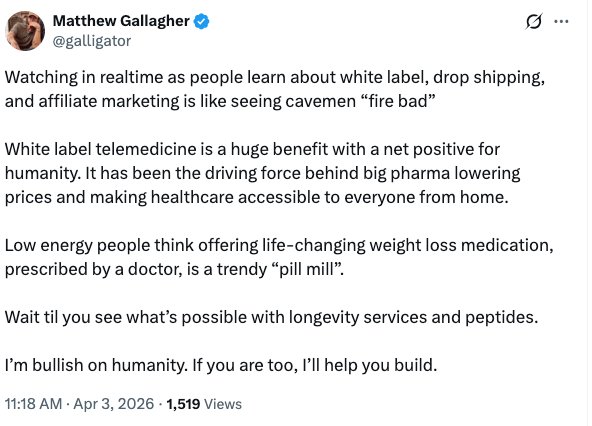
Relatedly, STAT featured an opinion piece titled “My patient would rather take a peptide than a statin. That reveals an uncomfortable truth in medicine.” In it, a doctor tells the story of a patient who stopped taking her statin in favor of BPC-157.
CMS issued the final rule for the Medicare Advantage (MA) Program, Medicare Prescription Drug Benefit Program (Part D), and Medicare Cost Plan Program which “aims to improve quality and access to care for people enrolled in these programs by finalizing updates to MA and Part D Star Ratings quality measurements and streamlining certain enrollment processes.”
A handful of states are experimenting with alternative licensure pathways for internationally trained physicians as a creative way to ease provider shortages and improve access to primary care. Niskanen had this brief on Washington state’s recently passed legislation.
Advocate and drone delivery startup Zipline announce a partnership to “deliver prescriptions, labs, and other supplies to deliver 100,000+ items a year.”
A delay in implementation for two services in the WISeR model hit the Federal Register last week:
Deep Brain Stimulation for Essential Tremor and Parkinson’s Disease (NCD 160.24).
Percutaneous Image-Guided Lumbar Decompression for Spinal Stenosis (NCD 150.13).
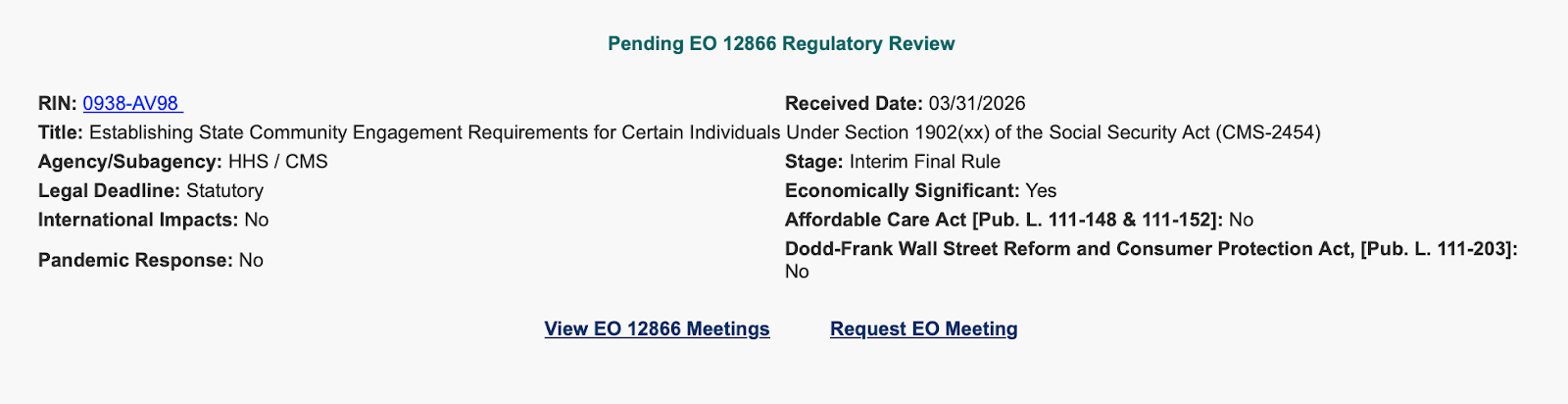
The long awaited Medicaid Community Engagement Requirements rule is at the OMB for regulatory review which means we’ll be seeing it relatively soon. KFF compiled this helpful list of operational and implementation questions


More from Health Tech Nerds
Weekly Health Tech Reads
March 29th, 2026: A musing on the peptide craze, a dozen different startup funding announcements, and more. Read here.
Weekly Health Policy Briefing
April 2nd, 2026: Inferred risk for ACOs and tough choices for state legislators and Medicaid agencies. Read here.